Short answer: Good B2B selling has always meant stating what is true and obvious, but the obvious has changed five times: from product features, to information overload, to reassurance, to co-creation, and now to business model reality. With AI making both sides transparent, a seller needs a structural advantage in financing, technology, logistics or intelligence.
Obvious Adams, the fictional ad man from the 1916 book, built his career on this. Cut through complexity. Say what's true. Let the customer see reality clearly, then decide.
Sales, it turns out, has always been about the obvious. But what counts as "obvious" keeps changing.
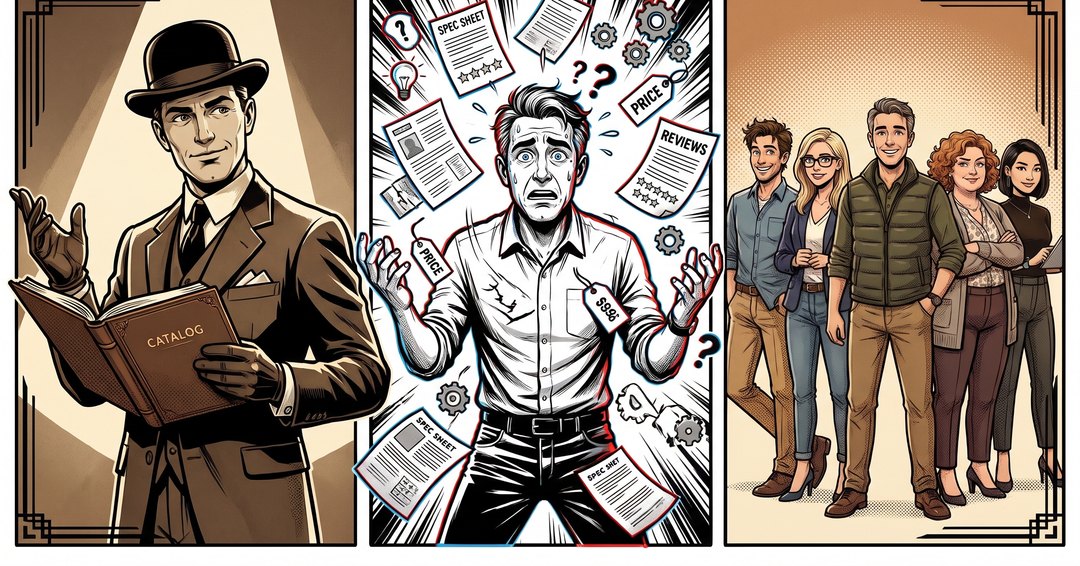
Era 1: Obvious meant features
Two decades ago, stating the obvious meant showing up with information the customer didn't have. I had the catalogs, the specifications, the technical details. The customer needed to know what the product did, what it cost, how long it lasted.
The obvious was simple: this machine does X, costs Y, lasts Z years.
The salesperson was the gatekeeper of knowledge, and the sale happened when that knowledge transferred cleanly. It was a straightforward exchange, and everyone understood their role in it.
Era 2: Google blurred everything
Then the internet arrived, and customers started educating themselves. They had access to specs, reviews, comparisons. Sometimes they knew more than the salesperson walking through the door.
We thought this was the end of traditional selling. Information asymmetry collapsed. But instead of clarity, we got something else entirely. The obvious became obscured by abundance. A hundred options, all claiming to be the best, all backed by data the customer could verify themselves.
Salespeople scrambled for relevance, trying to figure out what they could possibly offer that Google couldn't.
Era 3: The obvious became "you're not alone"
The market didn't just open up. It flooded. Chinese manufacturers learned to copy fast and efficiently, hitting markets with impossible discounts and moving on. Saturation became the norm, and with it came a new kind of paralysis.
Customers had all the information they needed, but it didn't help. More options meant more anxiety, not better decisions. They could research endlessly, compare specifications until their eyes glazed over, and still feel uncertain. And often, after making a purchase from the lowest bidder, they found themselves alone.
That's when the salesperson found a new role, and the obvious shifted again. It wasn't about features or prices anymore. It was about presence. It was about being the person who picks up the phone, who helps bundle a solution that makes sense, who offers perhaps mediocre prices and mediocre goods, but comes with a number that always answers.
Social intelligence became the currency. Feeling the room, reading tone, sensing hesitation. The Chinese manufacturers couldn't do that. They hit and ran, optimizing for volume and velocity. But a salesperson who could make a customer feel secure, supported, less alone? That person had value again.
Era 4: The obvious became "let's build this together"
In bigger, more complex sales, the game changed yet again. Sales became business development. The modern research calls it "co-creating value," and it's not just a buzzword. It's a description of what actually happens when deals get complicated.
In large B2B sales, you're not selling to one person. You're orchestrating multiple stakeholders on both sides: technical teams who care about integration, finance people who care about terms, end users who care about experience, executives who care about strategic fit. Each one has their own agenda, their own insecurities, their own ego that needs managing.
The salesperson became a conductor of sorts. The obvious wasn't a product feature or even a reassuring voice anymore. It was the ability to feel each individual in that complex web, to solve the micro ego issues that could derail everything, to translate between technical and executive language, and to hold space for a dozen people to arrive at "yes" together.
This is social intelligence at scale, and it's deeply human work. It's the kind of thing you can't learn from a manual, and it's the kind of value that justifies a salesperson's presence even when all the information is freely available.
Era 5: AI returns us to brutal obviousness
And now AI has arrived, and with it, another shift that feels both radical and strangely familiar.
AI doesn't just give customers more information. It makes everything transparent. The data heap gets mined, patterns emerge, and suddenly both sides can see things that used to be hidden. Customer weaknesses become visible. Product preferences get tracked and predicted. Margin pressure points are laid bare from all angles.
The margin battle becomes naked in a way it never was before. The dance stops. When both sides can see the cards, the game changes completely. We're back to stating the obvious, but this time it's not about product specifications or even emotional reassurance. It's structural. It's about business model reality.
The new obvious sounds different than it used to. It's more direct, sometimes uncomfortably so. It sounds like: if you don't have capital, you'll pay higher prices, or you might find yourself priced out of the game entirely. If you don't have a technology edge, you're competing in a commoditized space where margins compress toward zero. If your logistics can't match the speed and reliability of better-equipped competitors, you'll lose deals to whoever can ship faster and more predictably.
When transparency becomes total, only certain kinds of competitive advantages survive. Some companies compete on financial models: better terms, creative financing options, risk-sharing arrangements that make it easier for a customer to say yes. Others compete on technology: superior products, real innovation, integration advantages that can't be easily copied. Still others win on logistics: speed, reliability, availability when others can't deliver.
And perhaps there's a fourth model we're just beginning to understand. Call it the intelligence model. Not just data, but insight. Not just tracking what happened, but predicting what comes next. The ability to see what the customer needs before they know they need it. AI-powered foresight as a genuine differentiator, not just a feature to check off a list.
This is where my work lives now. I'm building systems that don't just track customer relationships but anticipate them. CRM that makes the next obvious move visible before anyone has to ask. It's infrastructure for this new era of transparent, structurally-honest selling.
Full circle
We've come back to Obvious Adams, but the landscape looks different now.
Today's obvious isn't about product features. It's about business model reality. It's about looking at a customer's situation clearly (their capital constraints, their technology gaps, their competitive position) and being willing to name what that means. Not cruelly, not dismissively, but honestly.
The salesperson who survives this era is the one who can still state what's true, even when the truth is uncomfortable. The one who can say: here's where you stand, here's what that means for your options, and here's what we might be able to build together given that reality.
It requires a particular kind of confidence. The kind that doesn't hide behind jargon or deflection. The kind that trusts the customer to handle the truth and make decisions from there.
The best salespeople were never afraid to state the obvious. They just had to keep figuring out what "obvious" meant as the world shifted around them. And right now, in this moment of radical transparency, it means something both simple and challenging: you either have a structural advantage, or you need to create one.
The companies that understand this early, that build their foundations around one of these enduring models, will have something solid to stand on. The ones that don't will keep wondering why the old playbook stopped working, why the techniques that used to close deals now feel hollow, why customers who seem interested keep drifting away.
The obvious, as always, is right there. The question is whether we're willing to see it and say it out loud.